

Cut Plan Fabric
This module is part of the Cut Plan and will be merged into that documentation.
Its main purpose is to track fabric usage and make consumption more efficient by reducing waste.
Design Mockup
Section titled “Design Mockup”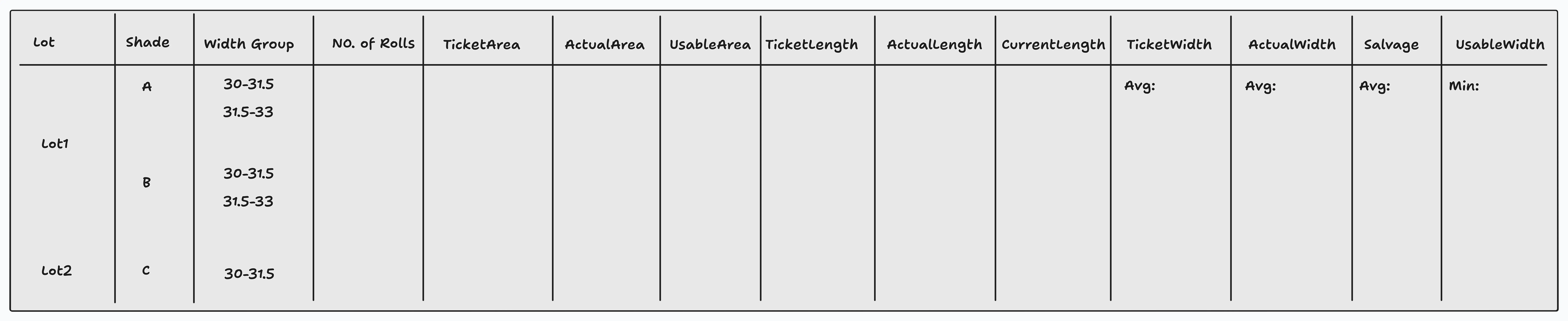
Explanation
Section titled “Explanation”The above mockup presents a detailed summary of the selected fabric in a cut plan, shown at the time of generating the master cut plan.
Each column represents the following:
-
Lot No - The lot number of the fabric roll.
(A lot refers to a large roll or batch of fabric dyed in one process.) -
Shade - The shade variation of the fabric roll within the same lot.
- Fabric from the same lot can have slight shade differences. For example, fabric closer to the dye source may appear darker compared to fabric further away.
-
Width Group - The width classification of fabric rolls within a shade of a lot.
- Rolls are grouped based on a user-defined threshold to minimize fabric wastage.
- Example: If there are 10 rolls starting at 60 inches wide and each roll increases by 1 inch, and the threshold is set to 1 inch:
- Group 1 → 60, 61
- Group 2 → 62, 63
- Group 3 → 64, 65
- Group 4 → 66, 67
- Group 5 → 68, 69
- This grouping ensures fabric is utilized with minimal waste.
-
Ticket Area - The area of fabric the vendor committed to deliver.
-
Actual Area - The area of fabric actually received in the warehouse.
-
Current Area - The remaining area of the fabric roll that has not yet been used in cutting.
-
Ticket Length - The committed length of fabric from the vendor.
-
Actual Length - The actual length of fabric received in the warehouse.
-
Current Length - The remaining length of the fabric roll available for cutting.
-
Ticket Width - The average fabric width committed by the vendor.
-
Actual Width - The average fabric width measured in the warehouse upon receipt.
-
Salvage - The unusable portion of the fabric roll (often threads fraying along the edges).
-
Usable Width - The minimum width determined within the width group of a shade in a lot.
- This ensures fabric cutting is done efficiently while accounting for variations.
Fabric Consumption
Section titled “Fabric Consumption”After this, the user will be required to provide the consumption for each size and for each selected fabric code. Consumption indicates how much area of fabric will be utilized to produce a single piece of clothing.